
Colorado’s Assisted Living Rules Have Grown 73% Since 2011. Has Anyone Measured Whether They Work?

Colorado keeps adding requirements in the name of resident health and safety. Without baselines, outcome targets, and post-adoption review, that claim remains an assumption.
In September 2011, Colorado's assisted living rule occupied 48 pages. The final pre-rewrite version was 43 pages in August 2015. The current official version, effective July 1, 2025, is 83 pages. That is 73% growth since 2011 and 93% growth from the final pre-2018 rule.
Page count does not prove overregulation. A short rule can be foolish and a long rule can be necessary. But nearly doubling a regulatory code should prompt a basic question: what measurable improvement did Colorado buy with all that additional prescription?
Some of the newer provisions address real dangers. Better medication practice, fall response, infection control, staff competency, background screening, and discharge protections can prevent serious harm. The problem is not that government tries to protect vulnerable residents. The problem is treating a rule's protective purpose as proof that the rule protects anyone.
The need to measure regulatory effectiveness is not a partisan proposition. President Barack Obama directed agencies to “measure, and seek to improve, the actual results” of regulatory requirements. President Donald Trump subsequently directed agencies to review existing regulations and identify those that were “outdated, unnecessary, or ineffective” or whose costs exceeded their benefits. Both principles point to the same conclusion: adopting a regulation should begin the evaluation process, not end it. Colorado should determine whether its assisted living regulations measurably improve resident health and whether those improvements justify the costs imposed.
The Regulatory Ratchet: More Rules Create More Violations
A regulator is asked to find noncompliance. New regulations create new ways to be noncompliant. More survey tags, corrective plans, and fines then create the appearance that more regulation was necessary. The absurd result is a system that validates its own expansion without ever showing that residents fell less often, suffered fewer medication injuries, avoided more hospital visits, or experienced safer transitions.
That is the logical defect at the center of regulation by accumulation. Licenses issued, surveys performed, deficiencies cited, fines assessed, and plans of correction accepted are measures of government activity. They are not measures of resident health. A regulatory system becomes irrational when it repeatedly adds process, measures the process, and then calls the process a health benefit.
A rational approach would define the problem before choosing the rule; identify the mechanism by which the rule is expected to reduce harm; quantify the expected cost and unintended effects; publish a target and review date; and revise or repeal the rule if the promised improvement does not appear. Colorado's assisted living framework does not consistently show that feedback loop.
How Much Has Chapter 7 Actually Changed?
The official history shows targeted amendments in 2014 and 2015, a complete rewrite in 2018, another full-rule revision in 2021, a major safety-and-enforcement package in 2023, and narrower fee and workforce-training changes in 2024 and 2025. The pivotal expansion was the 2018 rewrite, which added 26 pages. The next largest was the 2023 package, which added ten.
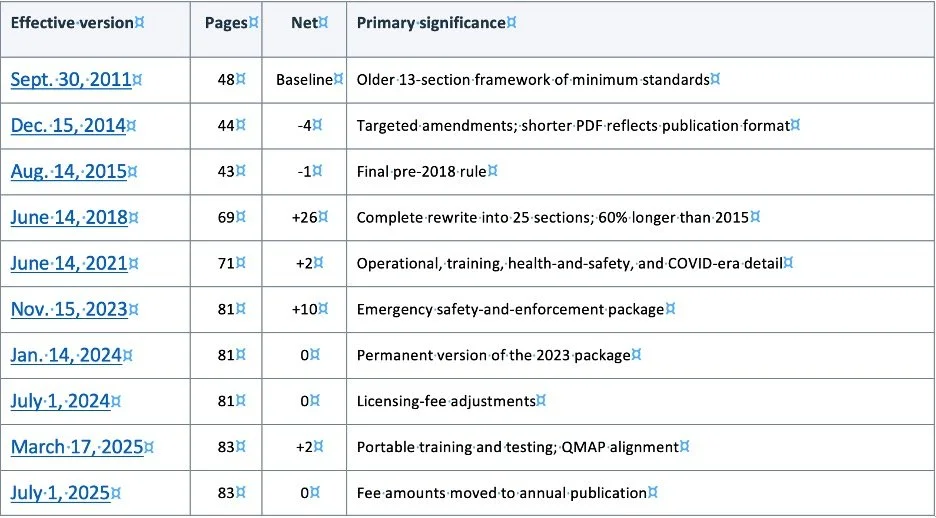
Page counts include editor's notes and rule history and are therefore approximate measures of regulatory content. The official archive shows no separate Chapter 7 amendment effective in 2019, 2020, or 2022.
The Direction of the Changes: From Standards to Prescribed Process
The 2011 rule was not regulation-free. Its thirteen principal sections already addressed licensing, staffing, administrator duties, resident rights and care, secure environments, dining, laundry, the physical plant, and emergency equipment. What changed most was not the existence of duties, but the degree to which the State prescribed the credentials, training, records, notices, investigations, and steps by which a provider had to prove compliance.
The 2018 rewrite built the modern 25-section structure. The 2021 revision added operational and training detail and incorporated lessons attributed to industry practice and the COVID-19 response. In 2023, rules implementing Senate Bill 22-154 strengthened administrator requirements, added Adult Protective Services data-system checks, expanded fines tied to harm, and created detailed notice, grievance, appeal, and hearing procedures for involuntary discharges.
The principal later packages implemented SB 22-154 on safety and enforcement and SB 24-167 on portable direct-care training and testing. The latter reform recognized, implicitly but importantly, that repeating the same training and testing at every new employer can consume resources without improving competency.
The regulatory trajectory continues. HB 26-1107 requires a dementia-care disclosure form beginning in 2027. Disclosure may help families compare facilities. But unless the State later measures whether the form improves placement decisions, reduces misleading representations, or prevents unsafe transfers, completion of the form may become another proxy for success rather than evidence of it.
Legislators Promised Results. Those Promises Should Be Tested.
When SB 22-154 became law, Senator Jessie Danielson said it would "hold assisted living facilities accountable, better protect older Coloradans, and prevent abuse and neglect". That is a serious and testable promise. Colorado should now be able to report whether substantiated abuse and neglect, repeat harm, unsafe discharges, and serious injuries declined after implementation.
Two years later, Senator Joann Ginal said the portability provisions in SB 24-167 would "improve care" while supporting the direct-care workforce. That too is testable: onboarding time and cost should fall, vacancies should close faster, turnover should improve, and resident outcomes should remain stable or improve.
Legislative statements of purpose matter. They tell us what success is supposed to look like. But a promise in a press release is not a finding. If the State never returns to the data, good intentions become a permanent substitute for proof.
Three Warnings from Colorado's Own Experience
1. A Building Standard Expanded Until the Legislature Had to Pull It Back
Colorado's assisted living regulatory environment applied Facility Guidelines Institute standards in ways that operators said made even bed additions without structural work costly and slow. In 2025, the General Assembly enacted HB 25-1213, directing that assisted living residences be exempt from FGI compliance except for new construction or major renovations. The signed act expressly states that adding beds without construction is not a major renovation.
Representative Lisa Feret described the correction this way: "I know it doesn't sound like big changes. But these are huge changes to people who are in the trenches." The episode matters because it shows how a safety-oriented standard can become disconnected from the risk it was meant to address. A requirement appropriate for new construction was used in circumstances where there was no construction, constrained capacity, and then required legislation to narrow it.
2. Repeated Training Became a Workforce Problem
Colorado required direct-care workers changing employers to repeat training or testing that could already have been completed. The 2024 portability legislation and 2025 rules were designed to correct that duplication while preserving employer competency checks. This is a sensible reform, but it is also an admission that compliance repetition is not the same thing as learning. The State should measure whether portability actually reduces onboarding delays and costs. If certificate requirements are so technical that employers cannot rely on them, the reform will exist on paper but not in practice.
3. The Oversight System Could Not Reliably Count Its Own Work
A July 2025 performance audit found that CDPHE's division could not reliably identify the total licensing surveys completed or complaints received. In the auditors' sample, all ten assisted living residences failed to receive the statutorily required annual survey, and seven of twenty sampled license-fee payments were calculated incorrectly.
Those findings do not prove that any particular resident was harmed. They prove something more basic: the State lacked reliable information about core activities it was already required to perform. If the regulator cannot reliably count surveys and complaints, it is difficult to see how it can evaluate whether a 73% expansion in the rules reduced resident harm. More requirements layered onto an inadequately measured system may increase the appearance of oversight while leaving the State less able to distinguish what matters.
The Cost of Getting This Wrong Is Not Just Paperwork
Regulatory burden can affect whether care exists at all. State figures reported in 2025 showed licensed assisted living beds falling from 25,633 in November 2024 to 25,393 in April 2025, with a reported loss of 205 Medicaid beds. Industry representatives attributed at least part of the contraction to regulation, inspection delays, and costs. Those assertions do not prove causation. But the bed loss is precisely the kind of warning signal the State should investigate rather than dismiss. See Colorado is losing assisted-living beds.
A rule can reduce one risk while worsening another. A building requirement may marginally improve a physical specification while preventing a small residence from adding beds. A training rule may standardize content while delaying hiring. A discharge process may protect a resident from an arbitrary removal while prolonging an unsafe placement. A fine may deter misconduct while causing a small Medicaid provider to close. The proper question is not whether a requirement has a plausible benefit. It is whether the net effect on residents is positive.
What the Department's Own Regulatory Analyses Reveal
The Department's 2023 regulatory analysis said the safety rules were generally expected to improve health, safety, and welfare. It discussed surveys, citations, re-surveys, enforcement actions, openings and closings, stakeholder input, and other regulatory sources. But it did not identify a baseline or numerical target for abuse, falls, medication harm, hospitalization, recurrence, or unsafe discharge. Stakeholders even questioned whether increased fines would improve compliance; the analysis answered principally that the statute required the fines.
The same analysis reasoned that facilities could avoid the economic impact of fines by complying with the rules. That is true in the abstract, but it assumes perfect clarity, perfect implementation, and perfect agreement about what compliance requires. It also ignores the cost of the systems needed to prove compliance and the possibility that a citation may be disputed or overturned.
The Department's 2024 analysis for the 2025 portability rules anticipated faster onboarding, improved retention, and more consistent training. It described certificate costs as minimal because stakeholders had not raised them as a concern. Yet its response to the request for quantification identified statutes and regulatory language, not numerical cost estimates or resident-outcome data.
These analyses may satisfy the mechanics of rulemaking. They do not demonstrate effectiveness. Terms such as anticipated, expected, possible, and may are appropriate before implementation. They are not enough years later. At some point, the State must compare the prediction with what happened.
If the Rules Protect Health, Where Is the Improvement?
The Department already receives information through surveys, complaints, occurrence reports, plans of correction, and enforcement proceedings, and it publishes facility information through its find-and-compare resources. The needed shift is from counting regulatory events to evaluating resident outcomes. At a minimum, Colorado should measure:
Falls and transfer injuries. Injurious falls per 1,000 resident-days, repeat falls within 30 days, and resident and staff injuries during lifts.
Medication-related harm. Errors requiring treatment, missed critical doses, adverse drug events, and medication-related emergency transfers per 1,000 medication passes.
Declining health and avoidable hospital use. Pressure injuries, significant weight loss, dehydration, serious infections, emergency visits, and admissions following a documented change in condition.
Abuse, neglect, and recurrence. Substantiated mistreatment per 100 residents, time from discovery to protective action, repeat harm, and severity of injury.
Discharges and transitions. Involuntary discharges, successful grievances and appeals, transfers without an accepting placement, and emergency use or hospitalization within 7 and 30 days after discharge.
Workforce stability and resident experience. Direct-care turnover, vacancy duration, time to onboard, reliance on temporary staff, response times, and resident and family experience.
Access and capacity. Openings, closures, licensed and occupied beds, Medicaid beds, admission delays, and rural or small-home capacity.
Regulatory burden and accuracy. Staff hours and dollars devoted to documentation, repeat training, surveys, and corrective plans; time required for State approvals; citation consistency; and the rate at which disputed findings are modified or withdrawn.
The Department's find-and-compare resources are a useful starting point, but a list of inspections and enforcement actions does not answer whether residents are healthier. Our earlier articles explain both when discharge may be required and how providers can challenge serious deficiency findings. Those are areas where outcome and accuracy measures are especially important.
A Simple Discipline for Future Rules
For every material rule package, CDPHE and the Board of Health should publish a one-page scorecard before adoption: the specific harm being addressed (something more scientific than a vague reference “best practices” please); the causal reason the proposed requirement should reduce it; the baseline rate; the expected improvement; the direct and indirect cost; the possible unintended consequences; the data source; and the date on which the rule will be reviewed.
After implementation, the State should compare the same residences over time, use consistent denominators such as resident-days or medication passes, and adjust for facility size, resident acuity, dementia prevalence, and other material differences. It should separate increased reporting from increased harm and isolated incidents from repeated failures. It should also compare small homes, larger campuses, Medicaid-serving facilities, and rural providers because a uniform rule can impose very different burdens, and state law requires it.
Requirements associated with fewer serious harms should be retained and strengthened. Requirements that produce no measurable benefit should be simplified, narrowed, or allowed to expire. Requirements that reduce one harm but materially reduce access should be redesigned. No regulation should become permanent merely because the agency has learned to administer it.
Bottom Line
Colorado's assisted living regulations are plainly longer, more prescriptive, and easier to enforce than they were in 2011. What is not plain is whether residents are measurably healthier or safer. The State has made promises, added procedures, expanded penalties, and collected more documentation. Its own recent audit found that the licensing division could not reliably count basic parts of its work.
That is not a case for abandoning resident protection. It is a case for taking protection seriously enough to measure it. If preventable harms have declined, CDPHE should show the evidence and connect the improvement to the requirements that worked. If they have not, the answer should not automatically be more pages, paperwork, and penalties. Regulation without outcome measurement is not evidence-based health protection. It is faith in regulation itself.
Educational use only. This article provides general information and is not legal, licensing, tax, accounting, insurance, investment, lending, or financial advice. Assisted living requirements change over time and may apply differently to particular facts. Operators should consult qualified professionals and the applicable licensing agencies before acting.
We welcome your feedback and topic suggestions. Email Brian@Pinkowskilaw.com with questions you would like to see addressed in a future article.